
FarSync Flex
The FarSync Flex USB adapters have been developed to provide industry trusted sync and async communications support for Linux and Windows systems with multiple line signalling modes.


Overview
*Final Stock*
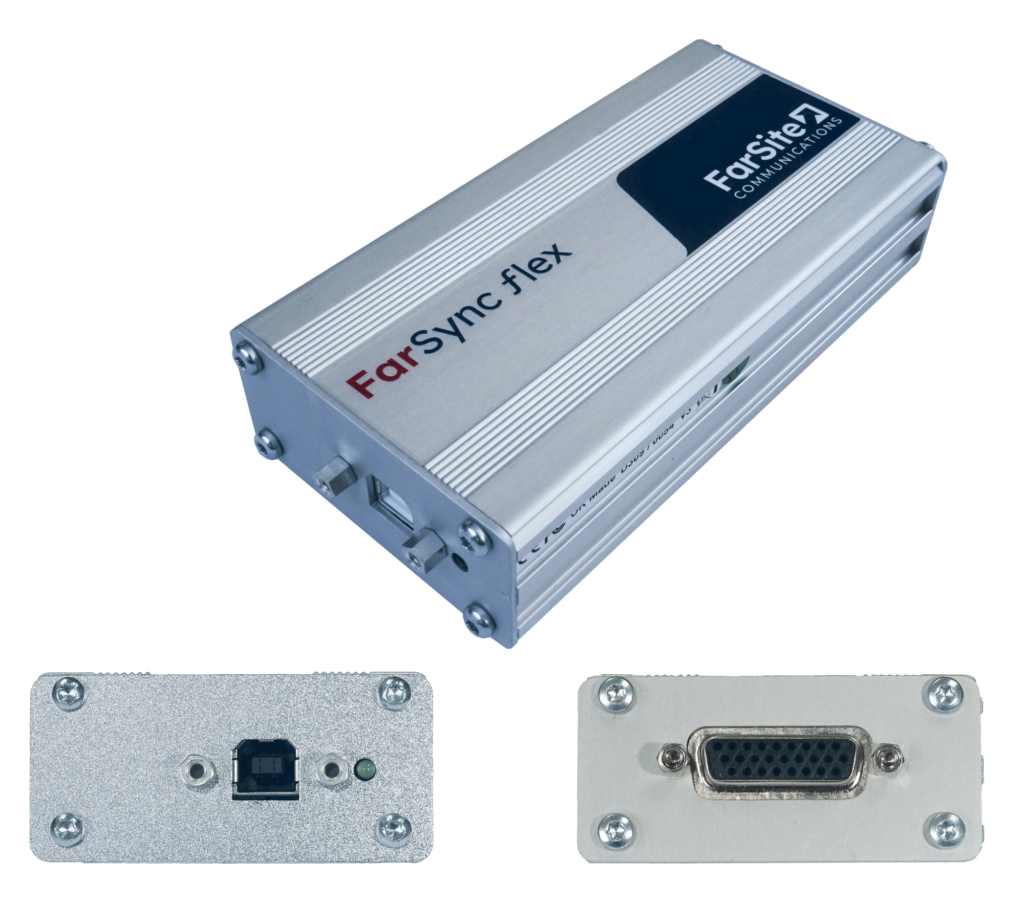
The FarSync Flex USB adapter is a high quality synchronous device for business, government and military applications. Using the FarSite customisable communications controller it has been developed to provide a high performance, neat, durable solution with versatile connectivity for Linux and Windows systems.
The bus powered USB adapter will support synchronous line at speeds of up to 3 Mbits/s continuous or up to 20Mbits/s with the high performance version, the Flex+.
The highly flexible universal network connector supports RS232, X.21, RS530 (RS422 signaling), RS449 , RS485 and V.35 network interfaces.
Writing your own application to access our FarSync device? You will need to order the FarSync SDK alongside your hardware. One license is required per department or project.
The Flex+ can be used for passive line monitoring with the addition of a special monitor cable. A monitoring application is included which captures line traces which can be viewed in realtime or saved as pcap files, for subsequent, offline viewing in applications such as Wireshark.
For DAB connections the FarSync Flex supports ETI (NI, V.11) and STI (PI, V.11).
The intelligent FarSync Flex is designed for reliability, high performance and flexibility. The adapter uses a fast ARM processor with Flash and RAM for the onboard code.
- The multi function line drivers available on both ports support X.21 (V.11), V.35, RS232 (V.24, X.21bis), RS530 (EIA530, RS422), RS449 and RS485 2 and 4 wire network interfaces, all soft configurable and ESD protected from static charges.
- Flex gives Sync line speeds up to 3 Mbits/s, Async line speeds up to 115.2 Kbits/s
- Flex+ gives Sync line speeds up to 20 Mbits/s, Async line speeds up to 115.2 Kbits/s
- USB 2.0 high-speed mode (480mb/s), USB 3 and USB 1.1 compatible
- Multiple Flex operation from a single server
- High efficiency USB Bus powered, energy saving design
- NRZI, NRZ, Manchester Encoding, Conditioned Di-phase, FM0 and FM1 line signaling formats, tri-state transmitters and receivers
- Master or slave support for 2 or 4 wire multidrop (NRZI, Manchester Encoding, Conditioned Di-phase, FM0 or FM1) RS485 operation
- Line clocking external or internal for 100’s of synthesizer generated clock speeds with fully configurable bidirectional clocking
- Custom clock rates configurable dynamically through the API with glitch free transition between rates
- Dual bank flash for secure in field upgrades and previous system restore capability
- Software selectable Synchronous HDLC, Transparent Bitstream and Asynchronous formats
- FarSite customisable communications controller
- New releases of the software available for free download from the Download page in this web site’s Support section
- Optional mounting brackets (factory fitted)
- Board only and blank case options for OEM requirements
The FarSync Flex is supplied with support for Windows and Linux. This includes a low level driver that allows access to the communications features available in the hardware. Multiple devices can be installed.
FarSync adapters support Linux kernel versions from 2.6.12 onwards, in 32 and 64 bit formats, including the leading distributions supplied by Red Hat, SuSE, CentOS, Ubuntu, Debian, Fedora, Slackware and more.
FarSite is committed to supporting FarSync adapters on new versions of Linux and Linux kernels as they are released.
Installation is simple, the driver is dynamically loadable so a kernel rebuild is not required for the driver to be installed. The driver acts as a dynamically loadable module. The driver is supplied with source code. The driver supports both big-endian and little-endian memory storage formats.
This adapter can be accessed from customers’ native Linux applications as well as those using third-party frameworks such as LabVIEW.
The char-based FarSync API provides a programming language independent, high-level interface to the FarSync base driver. This provides access to bit synchronous lines that are using HDLC-framed or transparent bitstreams. In addition asynchronous lines are supported by FarSync adapters that support async operation (FarSync Flex/Flex+ and FarSync T4E).
A configuration utility is provided to set each port’s line speed, interface type etc. Alternatively the port configuration can optionally be managed by a user application developed using the FarSync API.
If the host TCP/IP stack is required to be used over the FarSync adapter to allow access to IP-based networks, such as the Internet, then please just contact us for more information.
The FarSync adapters install easily under Windows 11, 10, Windows Server 2025, 2022 and 2019 on single or multi-core 32 and 64 bit systems (excluding IoT editions). The FarSync drivers are signed by Microsoft for easy installation. For use on earlier Windows versions contact FarSite.
This adapter can be accessed from customers’ native Windows applications as well as those using third-party frameworks such as LabVIEW.
All FarSync cards/devices are supported by a set of Windows FarSync drivers that support FsWinAPI, an API that provides a consistent interface across all classes of FarSync cards/adapters. LabVIEW applications can also run over FsWinAPI thereby enabling VIs to utilise the FarSync ports.
FsWinAPI allows applications developed using the FarSync SDK to exactly control the type of data sent and received in bit synchronous (HDLC framed) data and transparent bitstream formats.
The FsWinAPI is an extension of the MS COMM API and enables, for example, applications developed to support COM ports, to be easily ported to use FarSync support in synchronous or asynchronous modes. This standardization enables the API to also be readily accessible from higher level environments such as .NET, C#, VB etc. The API provides applications with access to the card/device’s communications port/s for bit sync HDLC-framing or transparent bitstream operation (video and voice type applications). In addition asynchronous lines are supported by FarSync adapters that support async operation (FarSync Flex/Flex+ and FarSync T4Ee).
The product is supplied with a comprehensive configuration utility and its own Line Monitor that allows the user to record, display and store line traffic with WAN protocol decoding for fast debugging.
The FarSync Flex capability has now been extended with the addition of the FarSync Flex+ which offers higher speeds and additional functionality.
This high performance version supports:
- Synchronous line rates of up to 20 Mbits/s and async line speeds up to 115.2 Kbits/s
- LAPB protocol support – for use with lines running the LAPB level 2 protocol (as opposed to the HDLC framing of user data).
- Passive monitoring capability – this enables network engineers to monitor existing lines and to capture the synchronous or asynchronous traffic passively, without the need to act as an endpoint on the line.

 The FarSync SDK provides a Developers Toolkit with full documentation, useful utilities, such as a line monitor, and many sample applications for Linux and Windows. Free support from FarSite’s Engineering department is provided to customers purchasing the FarSync SDK who have technical questions using the API.
Writing your own application? You will need to order the FarSync SDK alongside your hardware. One license is required per department or project.
The SDK includes support for writing applications on both Linux and Windows and contains documentation, working sample applications, development and test utility applications. There is everything a user needs to rapidly develop and test a wide variety of applications such as specialist synchronous (HDLC framed) protocols or transparent bitstream data requirements including Audio, MPEG Video T-DMB and DAB ETI with bitstream encoder and decoder.
The FarSync SDK is ordered separately from the FarSync adapter.
Our Engineering department provides free email and telephone assistance to application developers using the API as part of the package provided when the FarSync SDK is purchased.
See details on the FarSync SDK Developers Toolkit and the APIs supported.
The FarSync Flex adapters are suitable for a very wide range of uses. Typical applications include:
- HDLC framing support for non standard or specialist protocols
- LAPB line mode available with the Flex+
- Interfacing to transparent bitstreams for handling unusual protocols
- Line monitoring (both transmit and receive). For passive line monitoring choose Flex+
- Data generator for test systems
- Engineering monitoring and for control of systems
- Master or slave in a RS485 2 or 4 wire multidrop environment
- Connection to radio modems controlling data rate using dynamically variable clock speeds
- Interfacing video and voice bitstreams such as T-DMB, DAB ETI (N1, V.11) and STI (P1, V.11)
Technical specifications / functionality in detail
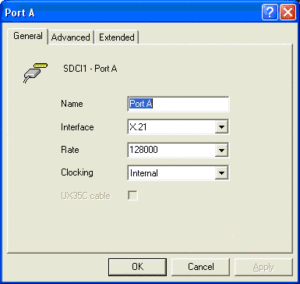
For Windows, configuration is by a GUI application. A typical screen is shown below.
The port can be reconfigured and restarted without reloading the software.
There is context sensitive help and an on-line manual should it be required. An advanced tab permits users to further specify the configuration of the port if necessary.
For Linux, a configuration utility is provided; alternatively text files can be used.
| Linux | |
|---|---|
| Distribution and Kernel Support | FarSync adapters support Linux kernel versions from 2.6.12 onwards, in 32 and 64 bit formats, including the leading distributions supplied by Red Hat, SuSE, CentOS, Ubuntu, Debian, Fedora, Slackware and more. The products may operate successfully with earlier or later versions of the kernel but no specific testing has been undertaken by FarSite. Big Endian and Little Endian memory storage format drivers supplied. |
| Protocol Supported | Cisco HDLC, LAPB (Flex+ only), Frame Relay, CHAP, MSCHAP, PAP (RFCs 1661, 1332, 1334). Bitstream. ETI (NI, V.11) with the FarSync SDK. |
| API and Interfaces | Char I/O API |
| Windows | |
| O/S Types | The FarSync adapters install easily under Windows 11, 10, Windows Server 2025, 2022 and 2019 on single or multi-core 32 and 64 bit systems (excluding IoT editions). The FarSync drivers are signed by Microsoft for easy installation. For use on earlier Windows versions contact FarSite.
This adapter can be accessed from customers’ native Windows applications as well as those using third-party frameworks such as LabVIEW. |
| Protocol Supported | HDLC, LAPB (Flex+ only), V.120, ETI (NI, V.11), Bitstream. |
| API and Interfaces | FsWinAPI |
| Utilities | Line Monitor to record, display and store line traffic included |
| General | Intelligent USB adapter with ARM processor, dedicated RAM and dual bank Flash memory, Field upgradeable onboard firmware, USB bus powered, USB 2.0 (high-speed - 480mb/s mode) USB 3 and USB 1.1 compatible, Network line connector: HD26 for connection of network cables |
||
| Physical characteristics | Dimensions: - Height 30mm, Length 126 mm, Width 62mm, Weight: 190g, Cable (supplied): 0.6 metre A to B USB cable with thumb screw secured B connector. |
||
| Network connections supported | RS232 – DTE DB25M connector, DCE type cables are also available |
||
| Link speed range | RS232: up to 128 Kbits/s, X.21, V.35, RS530, RS449, RS422, RS485: up to 3 Mbits/s or 20Mbits/s with Flex+ |
||
| Sync and Async | Synchronous operation up to 3 Mbits/s, or 20Mbits/s with Flex+ Asynchronous operation up to 115.2 KBits/s |
||
| Line Signal Modes | NRZ, NRZI, FM0, FM1, Manchester Encoding and Conditioned Di-phase to well over 3 Mbits/s | ||
| ESD protection | Yes, Littelfuse high speed ESD and over-voltage protection |
||
| Indicators | LED displaying network line status | ||
| Approvals | EN55022 class B, CE, FCC class B |
||
| Power requirements | USB Bus powered, < 500 mA on full load, < 2 watt | ||
| MTBF | MTBF: 360,181 hours - calculation based on Bellcore Method 1 Case 3, 40°C ambient, 15°C case temperature rise above ambient. | ||
| Operating Temperature Range | –40°C to 85°C ambient air temperature. (industrial temperature range) | ||
| Humidity Range | 5% to 95% RH operating (non-condensing), 5% to 95% RH storage (non-condensing) |
||
| Line clocking (internal/external) | Internal and externally generated line clocking is supported, Internal clock range 100 baud up to 3Mbits/s (Flex) and 20Mbits/s (Flex+) on X.21, V.35, RS530, RS422, RS449 and RS485, Internal clock range 100 baud to 128 Kbits/s on RS232 (V.24), Custom clock rates are dynamically configurable through the API with glitch free transitions. |
||
| Extra Line Control | Bit reversal, receive clock inversion, configurable resistive interface signal termination. Full configurable bidirectional clocking. |
||
| Cable type compatibility | Cables are ordered separately see list of cables available | ||
| Warranty | 5 years | ||
| Compliance | RoHS2 and REACH | ||
Order information
The software firmware, drivers, utilities are included with the FarSync adapter. Cables are ordered separately.
The software and documentation is downloaded from this website using a code supplied with the FarSync adapter, it includes:
- Drivers for Linux and Windows
- Source code for Linux drivers
- Network monitor and various useful utility programs
- USB connected adapters include a USB-F cable
New releases of the software with enhancements and fixes are made available for free download from the Download page in the Support section of this web site.
The Developer’s Toolkit is ordered separately and supplied as a download
| Product Name | Description | Product Code |
|---|---|---|
| FarSync Flex | 1 port USB synchronous and asynchronous adapter (X.21 / V.35 / RS232 / EIA530 / RS422 / RS449 / RS485), async, bitstream and HDLC run-time support for custom applications and a Line Monitor. NRZ, NRZI, FM1, FM0, Manchester Encoding, Conditioned Di-Phase Selectable. - Sync line speeds up to 3 Mbits/s, Async line speeds up to 115.2 Kbits/s * | FS4100 |
| FarSync Flex+ | High Performance 1 port USB synchronous and asynchronous adapter (X.21 / V.35 / RS232 / EIA530 / RS422 / RS449 / RS485), async, bitstream and HDLC run-time support for custom applications and a Line Monitor. NRZ, NRZI, FM1, FM0, Manchester Encoding, Conditioned Di-Phase Selectable. - Sync line speeds up to 20 Mbits/s, Async line speeds up to 115.2 Kbits/s - LAPB support - Passive monitoring capability | FS4185 |
| FarSync SDK | The Linux and Windows Developers Toolkit for the FarSync Flex - required if you want to write software to use the adapters API | FS9610 |
| FarSync Flex X25 | Supports all the features of the FarSync Flex plus X.25 support and an X.25 SDK* | FS6100 |
| * If you require the FarSync Flex for use with Nokia Siemens Networks LMT software then please contact us. |
| Product Name | Description | Product Code |
| KCR1 | RS232 (V.24, X.21bis) and RS530 (EIA530, RS422) DTE cable. DB25M connector, same cable for both interfaces, 1.5 metres | FS6011 |
| KCR1-DCE | RS232 (V.24, X.21bis) and RS530 (EIA530, RS422) DCE cable. DB25F connector, Same cable for both interfaces, 2 metres | FS6070 |
| UCX1 | X.21 (V.11) DTE cable. DB15M connector, 1.5 metres | FS6062 |
| UCX1-DCE | X.21 (V.11) DCE cable. DB15F, 2 metres | FS6075 |
| UCV1 | V.35 DTE cable. MRAC-34 (V.35M) connector, 1.5 metres | FS6063 |
| UX35C | V.35 DCE cable. MRAC-34 (V.35F) connector, 1.5 metres. | FS6095 |
| KC449 | RS449 (RS422) DTE cable. DB37M connector, 1.5 metres | FS6019 |
| KCR-MON | Monitor Cable - RS232 (V.24) and RS530 (RS422, EIA530) with DB25M to DB25F passthrough, 1.5 metres | FS6016 |
| KCX-MON | Monitor Cable - X.21 (V.11) with DB15M to DB15F passthrough, 1.5 metres | FS6017 |
| TEST-T2U | Loopback connector - for T2U, T2Ue and Flex, communications port testing | FS6024 |
| Product Name | Photo | Description | Product Code |
| Flex Mounting Kit - metal |  | A pair of FarSync Flex mounting brackets. Must be ordered with the FarSync Flex as it is a factory fit only. Should only be used if a metal mounting bracket is required. | FS4901 |
| Flex Mounting Kit - plastic |  | A pair of FarSync Flex mounting brackets (recommended when fixing the location of the Flex case is required). Can be retrofitted, easy to fit, no disassembly of the Flex case is required to fit. | FS4902 |