
FarSync T4Ue and T4U
4 port synchronous cards
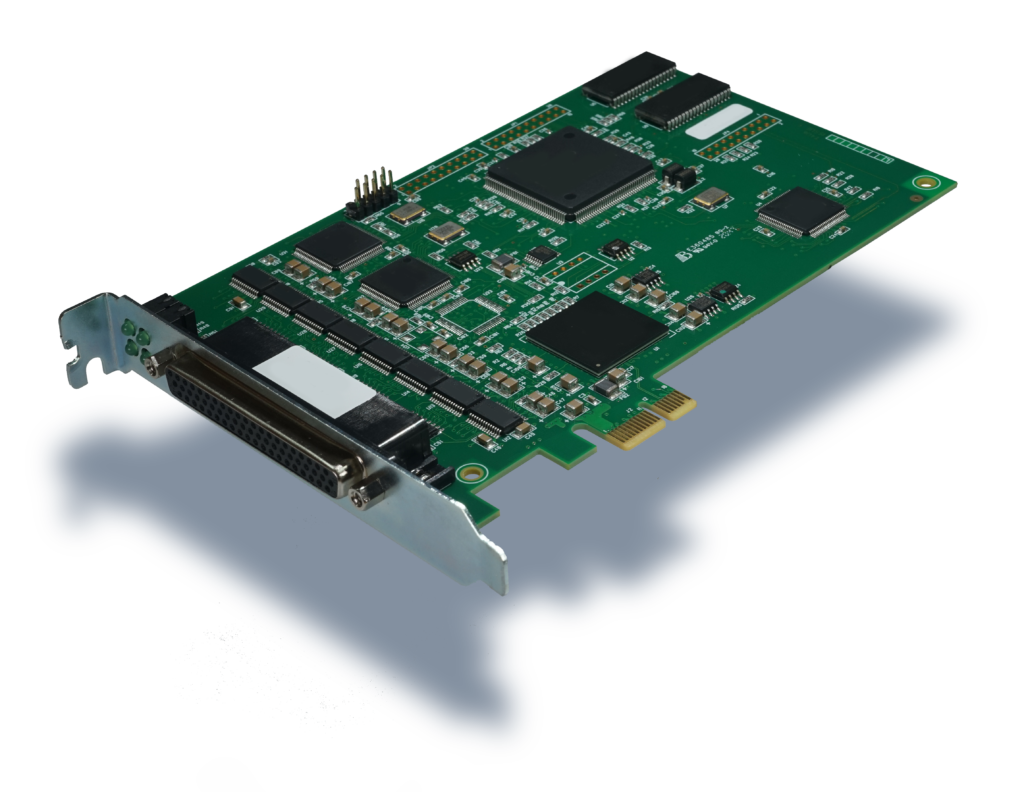
The FarSync T4Ue PCIe card provide high performance 4 port sync communications support for Linux and Windows systems. A PCI version of the card is also available.

Overview
The FarSync T4Ue card and software is designed to provide high performance hardware communications solutions for business, government and the military who need a PCIe synchronous communications card. The product includes a low level driver that allows access to the communications features available in the hardware. The FarSync SDK provides a Developers Toolkit for the product.
The card will support a synchronous line at speeds of up to 10Mbits/s continuous. The highly flexible universal network connector supports RS232, X.21, RS530 (RS422 signalling), RS449 and V.35 network interfaces.
The card is also available with soft selectable asynchronous/synchronous support as well by ordering the FarSync T4Ue+Async model and a PCI version of the adapter, the FarSync T4U is available too.
The products are supplied with a 5 year warranty.
The FarSync adapters install easily under Windows 11, 10, 8.1, Windows Server 2022, 2019, on single or multi-core 32 and 64 bit systems. The FarSync drivers are signed by Microsoft for easy installation. For use on earlier Windows versions contact FarSite.

This adapter can be accessed from customers, native Windows applications as well as those using third-party frameworks such as LabVIEW.
A FsWinAPI driver is installed with the optional installation of an NDIS (LAN) driver. LabVIEW applications can access this adapter. The FsWinAPI allows applications developed using the FarSync SDK to exactly control the type of data sent and received in bit synchronous (HDLC framed) data and transparent bitstream formats.
The FsWinAPI is an extension of the MS COMM API and enables, for example, applications developed to support COM ports, to be easily ported to use FarSync support in synchronous or asynchronous modes. This standardization enables the API to also be readily accessible from higher level environments such as .NET, C#, VB etc. The API provides applications with direct access to the card’s communications port/s for bit sync (HDLC) framing, transparent bitstream operation (video and voice type applications) and also asynchronous data with FarSync adapters that support async operation.
If the host TCP/IP stack is required to be used over the FarSync adapter to allow access to IP-based networks, such as the Internet, then contact us for more information.
The product is supplied with a comprehensive configuration utility and its own Line Monitor that allows the user to record, display and store line traffic with WAN protocol decoding for fast debugging.
FarSync adapters support Linux kernel versions 2.6.12 and onwards in 32 and 64 bit formats, including the leading distributions supplied by Red Hat, SuSE, CentOS, Ubuntu, Debian, Fedora, Slackware and more.
FarSite is committed to supporting FarSync adapters on new versions of Linux and Linux kernels as they are released.
Installation is simple, the driver is dynamically loadable so a kernel rebuild is not required for the driver to be installed. The driver acts as a dynamically loadable module. The link level protocol can be PPP, Cisco HDLC or Frame Relay with optional authentication by CHAP, MSCHAP or PAP (RFC 1334) providing a standard point-to-point network interface. The driver is supplied with source code. The driver supports both big-endian and little-endian memory storage formats.
This adapter can be accessed from customers’ native Linux applications as well as those using third-party frameworks such as LabVIEW.
The Char I/O API provides a programming language independent, high-level interface to the FarSync base driver it supports access to bit synchronous (HDLC) framed, transparent bitstream and asynchronous data with FarSync adapters that support async operation.
A configuration utility is provided to set the line speed, interface type and protocol, after which the ports may be configured with standard networking tools.
If the host TCP/IP stack is required to be used over the FarSync adapter to allow access to IP-based networks, such as the Internet, then contact us for more information.
 The FarSync SDK provides a Developers Toolkit with full documentation, useful utilities, such as a line monitor, and many sample applications for Linux and Windows. Free support from FarSite’s Engineering department is provided to customers purchasing the FarSync SDK who have technical questions using the API.
The SDK includes support for writing applications on both Linux and Windows and contains documentation, working sample applications, development and test utility applications. There is everything a user needs to rapidly develop and test a wide variety of applications such as specialist synchronous (HDLC framed) protocols or transparent bitstream data requirements including Audio, MPEG Video T-DMB and DAB ETI with bitstream encoder and decoder.
The FarSync SDK is ordered separately from the FarSync adapter.
Our Engineering department provides free email and telephone assistance to application developers using the API as part of the package provided when the FarSync SDK is purchased.
See details on the FarSync SDK Developers Toolkit and the APIs supported.
The FarSync cards are suitable for a very wide range of uses; some typical applications include:
- High speed multi-port HDLC framing support for non standard or specialist protocols
- Interfacing DAB ETI (Ensemble Transport Interface – ETSI EN 300 799) transparent bit streams to Servers
- Interfacing MPEG Video bit streams T-DMB ETI to Servers
- Interfacing high speed MPEG Video bit streams to Servers
- Watchdog systems
- Data generators for test systems
- Engineering monitoring and control systems
- Line connection card for LabVIEW applications
- Use of bitstreaming for the implementation of non standard or specialist protocols
- Multi purpose multi port communication card supplying a wide range of card generated clock speeds, FarSync T4Ee especially recommended for this function
- Manchester Encoding or Conditioned Diphase for long, reliable, high speed self clocking lines, FarSync Flex, FarSync T2Ee or FarSync T4Ee recommended for this requirement
Product details
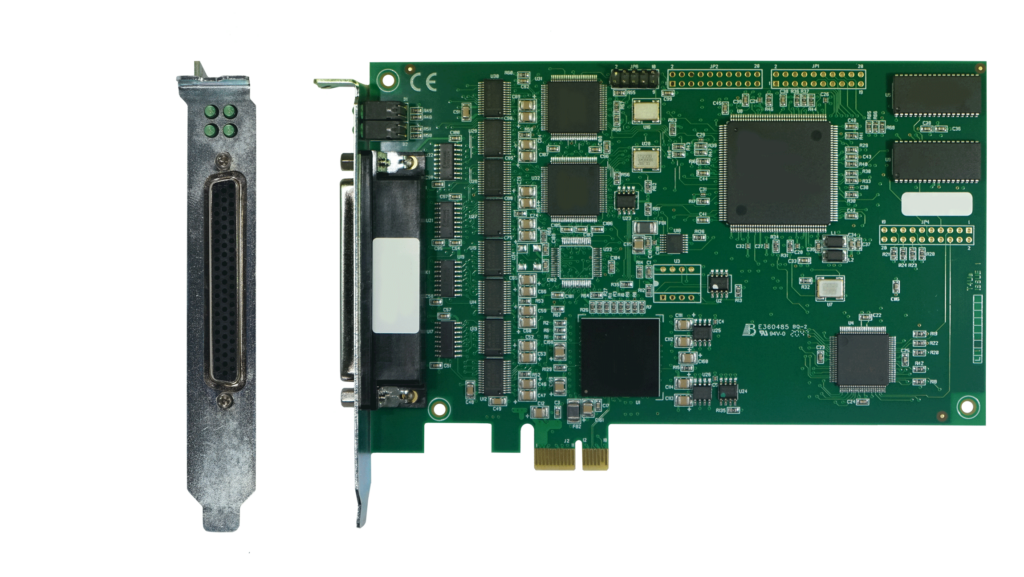
Both PCIe and PCI 4 port cards comprise an AMD processor with SRAM. The whole memory space may be mapped via the PCIe interface to the PC/Server. The card has a quad embedded HDLC / transparent controller with SDMA access (128 buffers per port) and a full range of timers. Total bandwidth supported by the card is 64 Mbits/s.
Network Interfaces
The multi function line drivers available on all the ports support X.21 (V.11), V.35, RS232 (V.24, X.21bis), RS530 (EIA530, RS422) and RS449 network interfaces, all soft configurable and ESD protected from static charges.
The maximum supported line speed is 10 Mbits/s full duplex.
Clock Generation
As well as external clocking the adapter support card generated clocks at a wide range of standard frequencies from 9,600 baud to 8.192 Mbits/s and dual clocks can be generated in V.11 mode if required. The clocking speed of all ports is individually selectable.
Multiple Cards
The drivers supplied with Windows and Linux allow large numbers of ports to be supported by the installation of multiple FarSync cards in a Server. Typically 12 or more cards (24+ ports) can be supported; the card limit is only dependent on the resources available in the host Server and the total bandwidth of the PCIe/PCI/PMC bus.
PCI Express Bus Specification
FarSync PCIe cards are suitable for systems with a PCIe bus, covering single and multi-processor systems. These cards are compliant with PCI Express Base specification revision 1.0a and above. The FarSync adapters are bus mastering, 1x (single lane) cards.
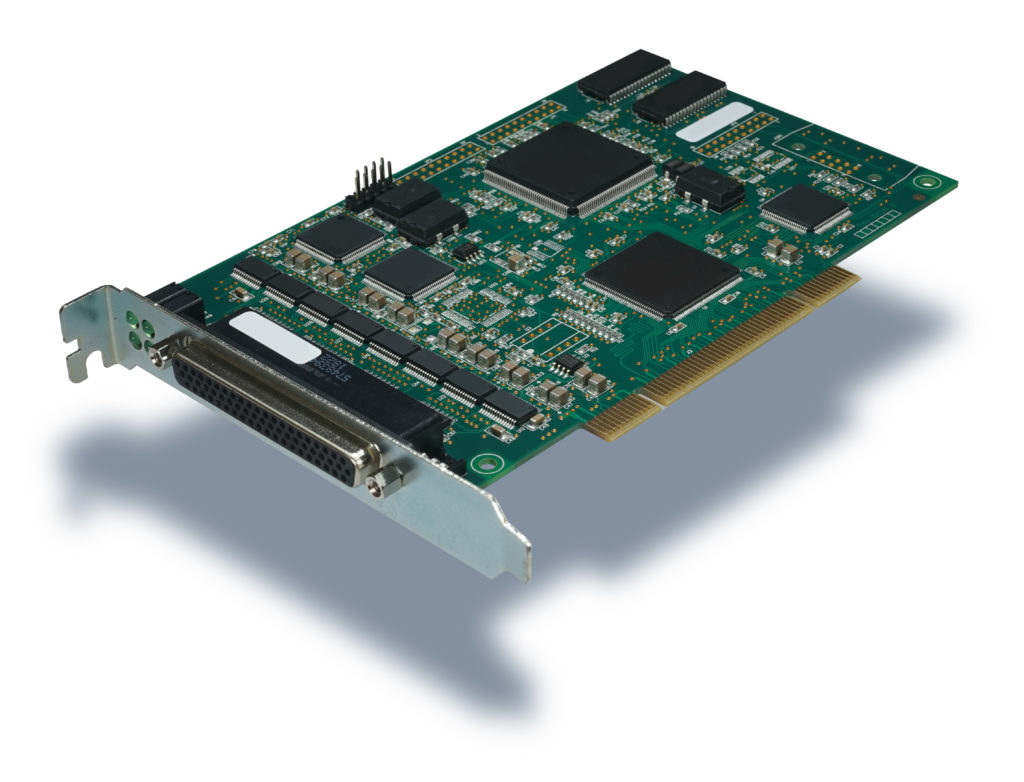
FarSync PCI cards comply with the Universal PCI (PCI-X compatible, PCI v2.2 compliant) specification. These bus mastering cards are suitable for systems with a PCI bus, covering single and multi-processor systems.
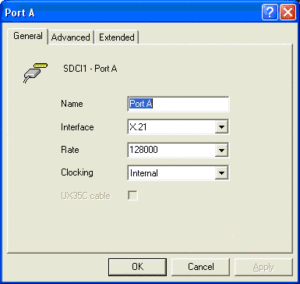
For Windows, configuration is by a GUI application. A typical screen is shown below.
The port can be reconfigured and restarted without reloading the software.
There is context sensitive help and an on-line manual should it be required. An advanced tab permits users to further specify the configuration of the port if necessary.
For Linux, a configuration utility is provided; alternatively text files can be used.
| Linux | |
|---|---|
| Distribution and Kernel Support | FarSync adapters support Linux kernel versions 2.6.12 and onwards in 32 and 64 bit formats, including the leading distributions supplied by Red Hat, SuSE, CentOS, Ubuntu, Debian, Fedora, Slackware and more. The products may operate successfully with earlier or later versions of the kernel but no specific testing has been undertaken by FarSite. Big Endian and Little Endian memory storage format drivers supplied. |
| Protocol Supported | TCP/IP, PPP, Cisco HDLC, LAPB, Frame Relay, CHAP, MSCHAP, PAP (RFCs 1661, 1332, 1334). Bitstream. ETI (NI, V.11) with the FarSync SDK. |
| API and Interfaces | Char I/O API |
| Windows | |
| O/S Types | The FarSync adapters install easily under Windows 11, 10, 8.1, Windows Server 2022, 2019, on single or multi-core 32 and 64 bit systems. The FarSync drivers are signed by Microsoft for easy installation. For use on earlier Windows versions contact FarSite.
This adapter can be accessed from customers, native Windows applications as well as those using third-party frameworks such as LabVIEW. |
| Protocol Supported | TCP/IP, PPP, LAPB, V.120, CHAP, PAP (RFCs 1661, 1332, 1334), ETI (NI, V.11), Bitstream. |
| API and Interfaces | FsWinAPI, NDIS (LAN) where the line appears as a LAN interface |
| Utilities | Line Monitor to record, display and store line traffic included |
| Card type and PCI specification | AMD processor with SRAM and quad port synchronous controller, PCIe bus compliant with PCI Express Base Specification Revision 1.0a, x1 (single lane), Bus mastering card The PCI version is Universal PCI (PCI-X compatible, PCI v2.2 compliant) |
| Physical characteristics | Short card (height 107mm, length 167mm) |
| Multiple cards | The drivers supplied with Windows and Linux allow large numbers of ports to be supported by the installation of multiple FarSync cards in a Server. Typically 12 or more cards (24+ ports) can be supported; the card limit is only dependent on the resources available in the host Server and the total bandwidth of the PCIe/PCI/PMC bus. |
| Network connections supported | 4 synchronous ports (FarSync T4Ue - FS4450) 4 synchronous or asynchronous ports (FarSync T4Ue+async - FS4451) 4 synchronous ports (FarSync T4U - FS4440) 4 X.25 ports (FarSync X25 T4Ue - FS6450) 4 X.25 ports (FarSync X25 T4U - FS6440) RS232 – DTE DB25M connector, DCE type cables are also available |
| Link speed range | RS232: up to 128 Kbits/s X.21, V.35, RS530 (RS422), RS449 (RS422): up to 10 Mbits/s |
| Line Signal Modes | NRZ |
| ESD protection | Littelfuse high speed ESD and over-voltage protection |
| Indicators | 4 LEDs displaying line status |
| Approvals | EN55022 class B, CE, FCC class B |
| Power requirements | < 1.75 A @ +3.3v < 10mA @ +/- 12v (for ESD suppression) < 6 watts |
| Operating Temperature Range | 0 to 60°C ambient air temperature. |
| MTBF | PCIe adapter: 229,044 hours PCI adapter: 238,319 hours Calculation based on Bellcore Method 1 Case 3, 40°C ambient, 15°C case temperature rise above ambient. |
| Line clocking (internal/external) | External and card generated line clocking is supported. The clock speed is independently selectable on each port. Card generated clock range 9,600 baud to 8,192 Mbits/s. No special cables are required to use card generated clocks on RS232, X.21 and RS530 (RS422). Internal clocking is supported on V.35 and RS449 with the use of cables designed for card generated clocks |
| Cable type compatibility | Cables are ordered separately see the Order Information section |
| Warranty | 5 years |
| Compliance | RoHS2, REACH |
Order Information
The software firmware, drivers, utilities are included with the FarSync adapter. Cables are ordered separately.
The software and documentation is downloaded from this website using a code supplied with the FarSync adapter, it includes:
- Drivers for Linux and Windows
- Source code for Linux drivers
- Network monitor and various useful utility programs
New releases of the software with enhancements and fixes are made available for free download from the Download page in the Support section of this web site.
The Developer’s Toolkit is ordered separately and supplied as a download
| Product Name | Description | Product Code |
| FarSync T4Ue | Intelligent PCIe (PCI Express) 4 port synchronous bus mastering card (X.21 / V.35 / RS232 / EIA530 / RS422 / RS449), bitstream and HDLC support. For Linux and Windows. Cables are ordered separately. | FS4450 |
| FarSync T4Ue+Async | Intelligent PCIe (PCI Express) 4 port synchronous and asynchronous bus mastering card (X.21 / V.35 / RS232 / EIA530 / RS422 / RS449), bitstream, async and HDLC support. For Linux and Windows. Cables are ordered separately. | FS4451 |
| FarSync T4U | Intelligent PCI 4 port synchronous bus mastering card (X.21 / V.35 / RS232 / EIA530 / RS422 / RS449), bitstream and HDLC support. For Linux and up to Windows 10 and Server 2019. Cables are ordered separately. | FS4440 |
| FarSync SDK | Linux and Windows Developers Toolkit - this is required if you want to write software to use the card's API | FS9610 |
| MCX4 | Quad X.21 (V.11) DTE cable DB15M connector, 1.5 metres, see pinouts | FS6041 |
| MCV4 | Quad V.35 DTE cable MRAC-34 (V.35M) connector, 1.5 metres, see pinouts | FS6042 |
| MCR4 | Quad RS232 (V.24) DTE cable DB25M connector, 1.5 metres, see pinouts | FS6043 |
| The MTU4 conversion cable (detailed below) allows single port cables to be connected so that different network connectors can be used on different ports | ||
| MTU4 | Quad port conversion cable 0.5 metres, allows UCR1, UCX1, U530, UCV1 and UX35C cables to be used | FS6074 |
| Test-T4P | Loopback connector connects directly to the card connector for testing the card communication ports operation. | FS6025 |
| These single port cables can be used by the FarSync T4Ue, X25 T4Ue, T4Ue+async, T4U and X25 T4U. In conjunction with the MTU4 quad port conversion cable they provide the capability to mix network connector types on a multi port adapter. |
||
| UCR1 | Single RS232 (V.24, X.21bis) DTE cable. DB25M connector, 1.5 metres, see pinouts | FS6061 |
| UCX1 | Single X.21 (V.11) DTE cable. DB15M connector, 1.5 metres, see pinouts | FS6062 |
| UCV1 | Single V.35 DTE cable MRAC-34 (V.35M) connector, 1.5 metres, see pinouts | FS6063 |
| U530 | Single RS-530 (EIA530, RS422) DTE cable DB25M connector, 1.5 metres, see pinouts | FS6064 |
| UX35C | Single V.35 special DCE cable MRAC-34 (V.35F) connector, where the DCE generates clocks, female connector, 1.5 metres. | FS6095 |
| Test-T2U | Loopback connector can be used for testing the communication ports of the MTU4 when the MTU4 is attached to the card, one Test-T2U required for each port. | FS6024 |
| Null-MX | General purpose X.21 double shielded crossover cable, DB15F connectors, 0.5 metres. Converts the DTE presentation into a DCE, see pinouts | FS6090 |
| X21-EXT | X.21 double shielded 15 metre extension cable, DB15F to DB15M | FS6091 |
| Null-MR4 | RS232 and RS530 (EIA530, RS422) double shielded crossover cable, DB25F connectors, 0.5 metres. Converts the DTE presentation into a DCE. | FS6097 |
| X.21-449-INT | X.21 to RS449 (DB37F connector) - conversion cable, for use when FarSync adapter generates the clock, 0.5 metres, see pinouts | FS6093 |
| X.21-449-EXT | X.21 to RS449 (DB37M connector)- conversion cable for use when the clock externally generated (DCE Clock), 0.5 metres, see pinouts | FS6094 |